
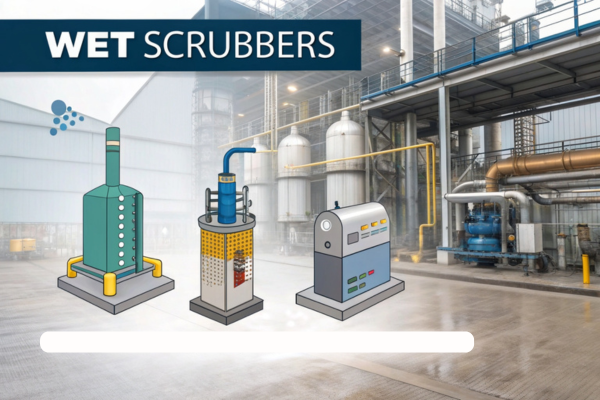
In industrial settings, maintaining air quality is essential not only for environmental health but also for worker safety. Wet scrubbers play a crucial role in air pollution control by capturing harmful particles and gases from exhaust air streams. These devices are widely used in manufacturing, chemical processing, and power plants to clean industrial emissions. In this article, we will delve into the wet scrubber advantages and disadvantages, providing an in-depth overview of their operation and functionality.
What are Wet Scrubbers?
A wet scrubber is an air pollution control device that uses liquid, typically water or a chemical solution, to remove pollutants from industrial exhaust gases. The process involves passing the contaminated air through a scrubbing liquid, which absorbs or neutralizes harmful particles and gases. The cleaned air is then released back into the atmosphere, while the pollutants are removed with the liquid.
Wet scrubbers are particularly effective in treating gases and particles that are either soluble or can be reacted with the scrubbing liquid. They are used to control air pollution in industries like chemical manufacturing, steel production, power generation, and waste incineration.
How Do Wet Scrubbers Work?
Wet scrubbers operate based on a principle called mass transfer, where pollutants from the gas phase are transferred into the liquid phase. This occurs through mechanisms like absorption, condensation, and chemical reactions. Here’s a breakdown of the process:
-
Gas Inlet: The contaminated air or gas enters the scrubber through an inlet.
-
Scrubbing Liquid: The gas stream comes into contact with the liquid in the scrubber, which captures pollutants.
-
Pollutant Removal: The liquid either dissolves, absorbs, or chemically reacts with the contaminants.
-
Clean Air Outlet: The cleaned air exits the scrubber, while the pollutants are carried away with the liquid.
-
Disposal of Pollutants: The pollutants in the liquid are either neutralized, treated, or disposed of in accordance with environmental regulations.
Wet scrubbers come in various designs, including venturi scrubbers, packed-bed scrubbers, and spray towers, each suited for specific types of pollutants and gas flows.
Types of Wet Scrubbers
-
Venturi Scrubbers: These scrubbers have a narrow throat that creates a high-velocity gas stream. The gas is mixed with the liquid, which helps capture particles and gases effectively.
-
Packed-Bed Scrubbers: These scrubbers contain packing material that provides a large surface area for the gas to contact the scrubbing liquid. They’re highly efficient in removing fine particles.
-
Spray Towers: In these scrubbers, the contaminated air passes through a shower of liquid droplets, which capture the pollutants.
Each type of wet scrubber has its unique benefits depending on the specific needs of the industry and the pollutants being treated.
Wet Scrubber Advantages and Disadvantages
As with any air purification system, wet scrubbers come with their own set of advantages and disadvantages. Let’s explore these in detail.
Wet Scrubber Advantages
-
Highly Effective in Pollutant Removal: Wet scrubbers are highly efficient at removing particulate matter, gases like sulfur dioxide (SO2), nitrogen oxides (NOx), and volatile organic compounds (VOCs).
-
Versatility: They can be used to treat a wide range of pollutants, including acidic gases, particulates, and certain chemicals, making them suitable for diverse industrial applications.
-
Low Operating Costs: Compared to some other pollution control devices, wet scrubbers often have lower operating and maintenance costs.
-
Simultaneous Removal of Multiple Contaminants: Wet scrubbers can handle both particulate matter and gases at the same time, unlike some other technologies that specialize in one or the other.
-
Scalable: These scrubbers can be customized and scaled to meet the requirements of different industries and air quality needs.
-
Environmental Compliance: Wet scrubbers help industries meet stringent environmental regulations by reducing emissions of harmful pollutants into the atmosphere.
Wet Scrubber Disadvantages
-
Water Consumption: Wet scrubbers use large amounts of water or chemical solutions, which can lead to high water usage, especially in areas where water is scarce.
-
Wastewater Disposal: The liquid used in the scrubbers can become contaminated with pollutants, creating a need for proper wastewater treatment and disposal.
-
Corrosion and Wear: The constant contact with water and pollutants can lead to corrosion and wear on the scrubber components, requiring regular maintenance and replacement.
-
Limited Efficiency for Low-Volume Gases: Wet scrubbers may not be as effective at treating low-concentration gases or small volumes of air compared to other technologies like dry scrubbers or activated carbon filters.
-
Space Requirements: Depending on the design, wet scrubbers can be bulky and require significant space within industrial facilities.
-
Energy Consumption: The pumps, fans, and other mechanical components of wet scrubbers can consume a significant amount of energy, leading to higher operational costs in some cases.
Choosing the Right Wet Scrubber for Your Industry
Selecting the appropriate wet scrubber for your facility depends on several factors:
-
Type of Pollutants: Identify the specific contaminants you need to remove, such as particulate matter, acidic gases, or VOCs.
-
Volume of Air: The size of your operation and the volume of exhaust gases will determine the capacity of the scrubber required.
-
Budget: While wet scrubbers are generally cost-effective, the initial investment and ongoing maintenance costs should be considered.
-
Environmental Regulations: Different regions have varying environmental standards for air pollution control. Ensure that the scrubber meets local regulations.
At Torch Air, we specialize in providing high-quality wet scrubbers designed to meet the air purification needs of industrial and manufacturing sectors. Our products are engineered to maximize efficiency while minimizing operational costs. For more information, visit our wet scrubber advantages and disadvantages operation manual.
Conclusion
Wet scrubbers are an essential tool for controlling air pollution in industrial and manufacturing environments. Their ability to remove a wide range of pollutants, coupled with their versatility and cost-effectiveness, makes them a go-to solution for many industries. However, like any technology, wet scrubbers come with certain limitations, such as water usage and maintenance requirements.
Understanding the wet scrubber advantages and disadvantages will help you make an informed decision when selecting the right air purification system for your facility. If you’re looking to invest in a high-quality, reliable scrubber, be sure to check out the full details in our wet scrubber operation manual.
